
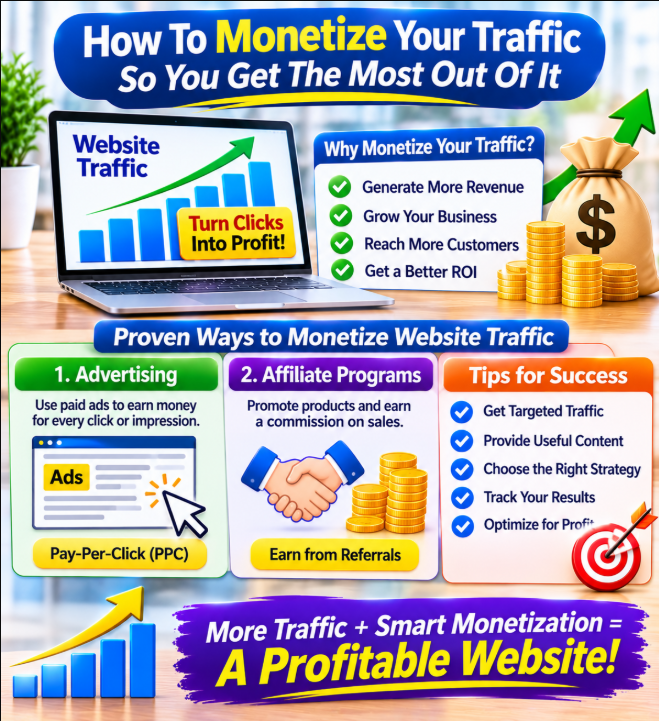
Building an e-commerce website or an online business is only the first step toward earning money online. Attracting visitors is important, but traffic alone does not guarantee sales or revenue. To build a sustainable online business, you need to turn relevant visitors into customers, leads, or other valuable actions.
Website monetization is the process of generating income from the visitors who come to your website. The right strategy depends on your audience, content, business goals, and the products or services you offer.
Whether you run an online store, a blog, or an informational website, understanding how to monetize your traffic can help you get more value from your online presence.
Why Website Traffic Matters
Website traffic represents the people who visit your pages and interact with your content. These visitors may be looking for information, comparing products, researching solutions, or preparing to make a purchase.
For an e-commerce business, attracting relevant visitors creates opportunities to generate sales. For a content-based website, visitors can create value through advertising, affiliate purchases, subscriptions, and other revenue opportunities.
However, it is important to understand that more traffic does not automatically mean more profit. A smaller audience with strong purchase intent may generate more revenue than a large audience that rarely takes action.
The goal should be to attract the right visitors and provide them with useful experiences that encourage meaningful engagement.
1. Monetize Your Traffic Through Advertising
Advertising is one of the most common ways to generate revenue from a website. Website owners can display advertisements from advertising networks or work directly with businesses that want to reach their audience.
There are several advertising payment models:
- Cost per click (CPC): You earn revenue when a visitor clicks on an advertisement, according to the advertising agreement.
- Cost per thousand impressions (CPM): Revenue is based on the number of times an advertisement is displayed, usually calculated per thousand impressions.
- Other performance-based models: Some advertising arrangements pay according to actions or results defined by the advertiser.
Advertising networks can simplify the process by connecting publishers with advertisers and providing tools to manage ad placements and revenue reporting.
Before choosing an advertising network, consider its eligibility requirements, payment terms, supported locations, content policies, and the types of advertisements it displays.
Make Advertising Work Without Hurting User Experience
Placing advertisements throughout your website may create additional revenue opportunities, but excessive advertising can frustrate visitors. Ads should not prevent people from reading content, navigating pages, or using important website features.
Consider these practices:
- Place advertisements where they are visible without disrupting the content.
- Avoid misleading layouts that make ads look like navigation buttons or editorial recommendations.
- Monitor page speed and mobile usability.
- Follow the advertising network’s policies.
- Review performance regularly and remove placements that create a poor user experience.
The objective is to balance advertising revenue with visitor satisfaction. A website that people trust and enjoy using has a better foundation for long-term growth.
2. Earn Commissions Through Affiliate Programs
Affiliate marketing is another effective way to monetize website traffic. Instead of selling every product yourself, you recommend relevant products or services offered by other businesses.
When a visitor clicks your unique affiliate link and completes a qualifying action, you may receive a commission. The action could be a purchase, a registration, or another activity specified by the affiliate program.
For example, a website that publishes articles about home improvement could recommend tools, furniture, or household products. If readers follow an affiliate link and make an eligible purchase, the website owner may earn a commission.
Affiliate marketing can be particularly useful for websites that publish product reviews, tutorials, comparisons, buying guides, and educational content.
How to Choose the Right Affiliate Programs
Not every affiliate program is suitable for every website. Promoting products that have little connection to your audience may reduce trust and produce few conversions.
Use these guidelines when selecting affiliate partners:
- Choose relevant products. Promote products or services that naturally relate to your website’s subject and audience.
- Check the commission structure. Understand how commissions are calculated and when payments are made.
- Review the program’s terms. Check cookie duration, eligible transactions, restrictions, and payment thresholds.
- Evaluate product quality. Avoid recommending products simply because they offer high commissions.
- Create helpful content. Explain product features, benefits, limitations, and practical uses honestly.
Always disclose affiliate relationships clearly. Readers should understand that you may earn a commission when they purchase through your links. Honest recommendations help maintain credibility and build long-term relationships with your audience.
3. Consider Other Ways to Monetize Your Website
Advertising and affiliate programs are useful starting points, but they are not the only ways to earn money from website traffic.
Depending on your audience and business model, you may also consider:
- Selling your own products: Offer physical goods, digital downloads, templates, or other products directly to visitors.
- Providing services: Turn relevant traffic into potential clients for consulting, design, coaching, or professional services.
- Offering memberships: Provide premium resources, exclusive content, or community access through recurring payments.
- Publishing sponsored content: Work with suitable brands to create clearly identified sponsored articles or other promotional material.
These approaches require different levels of effort, resources, and customer support. Choose a model that fits your capabilities and provides genuine value to your visitors.
4. Focus on the Quality of Your Traffic
A successful monetization strategy begins with attracting visitors who are genuinely interested in what your website offers.
For example, a visitor searching for a specific product comparison may be more likely to click an affiliate recommendation than someone who arrives at an unrelated article.
You can improve traffic quality by:
- Publishing useful, original, and relevant content.
- Researching the search terms your target audience uses.
- Optimizing page titles, headings, and descriptions for search engines.
- Building relevant internal links between related pages.
- Sharing content through appropriate online communities and social channels.
- Improving website navigation, mobile usability, and loading speed.
Avoid misleading headlines, artificial traffic, spam, or other methods designed to generate visits without providing real value. These practices can damage your reputation and may violate platform policies.
5. Track Performance and Improve Your Results
Monetization should be treated as an ongoing process. You need to understand which pages attract visitors, which traffic sources perform well, and which activities generate revenue.
Useful metrics include:
- Page views: The number of times pages are viewed.
- Traffic sources: Where visitors come from, such as search engines, social media, referrals, or direct visits.
- Click-through rate (CTR): The percentage of impressions that result in clicks.
- Conversion rate: The percentage of visitors who complete a desired action.
- Revenue per visitor: The average revenue generated by each visitor.
- Cost per acquisition (CPA): The cost of acquiring a customer or completing a defined action, when applicable.
Use analytics tools and the reporting dashboards provided by your advertising or affiliate partners to identify opportunities for improvement.
For example, if a page attracts substantial search traffic but produces few affiliate conversions, you may need to improve the relevance of the recommendations, make the content more useful, or clarify the next step for readers.
Test changes carefully and evaluate the results rather than assuming that more advertisements or more links will automatically increase revenue.
Conclusion: Turn Website Traffic Into Sustainable Revenue
Generating website traffic is an important achievement, but the real opportunity comes from using that traffic effectively. Advertising and affiliate marketing offer practical ways to earn income, while selling products, providing services, and offering memberships can create additional revenue streams.
The most effective approach is to understand your audience, select suitable monetization methods, publish valuable content, and measure your results consistently.
Remember that traffic does not automatically equal profit. Relevant visitors, trustworthy recommendations, a positive user experience, and a well-planned monetization strategy are what help turn a website into a sustainable online business.
