
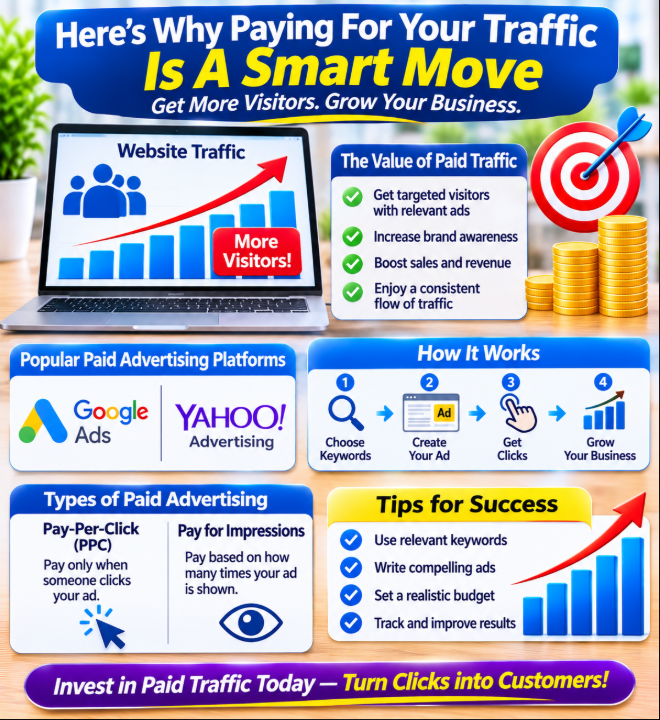
Building a successful online business requires more than creating a website and publishing products or services. People need to discover your website before they can become customers.
This is why website traffic plays such an important role in online business growth.
There are many stories of businesses achieving success through the internet. However, countless others struggle because they cannot attract enough visitors or reach the right audience.
Success rarely depends on luck alone. It requires careful planning, consistent effort, a good understanding of customers, and a willingness to invest in business development.
One strategy that businesses can consider is paid website traffic.
By investing in online advertising, businesses can introduce their websites to potential customers, increase brand awareness, and create more opportunities to generate sales.
In this article, we will explore why paid traffic can be a smart investment, how online advertising works, and how to use advertising budgets more effectively.
Understanding the Importance of Website Traffic
Website traffic refers to the visitors who access a website through different sources, including search engines, social media, referral links, direct visits, and paid advertisements.
For an online business, visitors represent potential customers.
Imagine owning a physical store in a shopping mall. Even if your products are excellent, you need people to enter the store before they can consider making a purchase.
An online business works in a similar way.
Without visitors, potential customers may never discover your products or services.
However, attracting visitors is only the first step. Not everyone who visits a website will make a purchase.
The important objective is to attract people who are genuinely interested in what your business offers.
Why More Traffic Can Create More Business Opportunities
A website with relevant visitors has more opportunities to introduce products, explain services, and generate customer inquiries.
For example, imagine an online store receiving 1,000 visitors in one month.
If 2% of those visitors complete a purchase, the store generates 20 sales.
If the website attracts 2,000 visitors while maintaining the same conversion rate, it could generate approximately 40 sales.
This example demonstrates how additional relevant traffic can create more sales opportunities.
However, actual results depend on many factors, including product quality, pricing, customer trust, website usability, and purchasing intent.
More visitors do not automatically guarantee more revenue.
The Basic Principle of Paid Website Traffic
One way to attract visitors is through paid online advertising.
Instead of waiting for potential customers to discover your website organically, you can pay an advertising platform to display your promotional messages to selected audiences.
Common paid advertising channels include:
- Google Ads
- Yahoo advertising products
- Social media advertising
- Display advertising networks
- Video advertising platforms
Each platform offers different targeting options, advertising formats, and pricing models.
The main objective is to connect your business with people who are likely to be interested in your products or services.
Why Businesses Invest in Paid Advertising
Businesses invest in paid advertising because it can provide access to audiences that might otherwise take considerable time to reach.
For example, a new online store selling smartphone accessories may use search advertising to reach people looking for phone cases, chargers, or screen protectors.
Instead of depending entirely on organic traffic, the business can use paid campaigns to introduce its products to relevant searchers.
This can help accelerate audience discovery and generate measurable website visits.
The Value of Search Engines
Search engines play an important role in helping people discover information, products, and services online.
When someone searches for a particular product or solution, search engines provide results that may include organic listings and sponsored advertisements.
This creates an opportunity for businesses to promote relevant products and services.
For example, imagine that you operate a business selling automotive components.
Potential customers might search for terms such as:
- Affordable car replacement parts
- Honda Accord brake pads
- Automotive accessories online
- Car battery replacement
By targeting relevant keywords through a search advertising campaign, your business may appear in sponsored placements when eligible searches occur.
This can introduce your website to people who are already looking for products related to your business.
Paid Search Advertising and Organic SEO
Paid advertising and search engine optimization are two different ways to attract visitors.
Paid search advertising allows businesses to pay for sponsored placements within supported advertising platforms.
Search engine optimization (SEO) focuses on improving website content, technical performance, and relevance to earn organic search visibility.
Paid advertisements can provide exposure while a business develops its organic presence.
However, paying for advertisements does not guarantee higher organic search rankings.
A balanced digital marketing strategy can use both methods to reach potential customers through different channels.
Why Paying for Website Traffic Can Be a Smart Investment
Paid traffic can provide several advantages when campaigns are planned and managed properly.
1. Reach Potential Customers Faster
Building organic visibility can take time, particularly for new websites competing in crowded industries.
Paid advertising offers another way to introduce a business to potential customers.
By targeting relevant keywords, locations, or audience interests, businesses can promote their products without relying exclusively on organic search discovery.
2. Increase Brand Awareness
Advertising helps more people become familiar with your business.
Even when someone does not immediately purchase a product, seeing your business name and message may increase brand recognition.
Repeated exposure to relevant advertising can help establish familiarity with potential customers.
3. Target Specific Audiences
Many advertising platforms provide targeting options that allow businesses to reach selected audiences.
Depending on the platform, advertisers may be able to target users based on:
- Search keywords
- Geographic locations
- Language preferences
- Interests
- Demographic information
- Previous website interactions
More precise targeting can help reduce unnecessary advertising exposure.
4. Control Your Advertising Budget
Paid advertising allows businesses to plan their spending according to available resources.
Many platforms provide daily budgets, campaign limits, or bidding controls.
For example, a small business could begin with a limited daily budget, monitor the results, and make adjustments before increasing its investment.
This approach helps businesses manage financial risk.
5. Measure Campaign Performance
One major advantage of digital advertising is the ability to measure campaign activity.
Businesses can monitor information such as:
- Number of impressions
- Total clicks
- Click-through rate
- Average cost per click
- Website conversions
- Cost per acquisition
- Return on advertising spend
These measurements help identify which campaigns are producing meaningful results.
Understanding Different Paid Advertising Models
Not every advertising platform charges businesses in the same way.
Understanding the pricing model is important when planning an advertising budget.
1. Pay-Per-Click (PPC)
Pay-per-click advertising charges advertisers when someone clicks on an advertisement.
For example, if your business spends $50 on a campaign and receives 100 clicks, the average cost per click is:
CPC = Advertising Cost ÷ Number of Clicks
$50 ÷ 100 = $0.50 per click.
PPC is commonly used in search advertising because advertisers can connect spending with user interactions.
2. Cost Per Thousand Impressions (CPM)
CPM advertising charges advertisers based on the number of times an advertisement is displayed.
CPM stands for cost per mille, meaning cost per thousand impressions.
For example, if a campaign has a CPM of $5 and generates 10,000 impressions, the estimated advertising cost is:
Advertising Cost = (Impressions ÷ 1,000) × CPM
(10,000 ÷ 1,000) × $5 = $50.
This model is commonly used for brand awareness and display advertising campaigns.
3. Other Advertising Models
Depending on the platform and campaign type, advertisers may also encounter pricing models based on video views, completed actions, or conversions.
The best model depends on the campaign objective.
For example, a business trying to increase brand exposure may prioritize impressions, while an online store may focus more on clicks and purchases.
How to Spend Your Advertising Budget Wisely
Paying for website traffic can be beneficial, but spending money without a clear strategy can quickly become expensive.
Here are several recommendations for managing advertising campaigns more effectively.
1. Choose Relevant Keywords
Keyword selection is essential for search advertising.
Choose search terms that accurately describe your products or services.
Avoid targeting broad keywords that may attract visitors with no purchasing interest.
For example, an online store selling professional camera equipment may benefit from targeting specific searches such as “professional camera lenses” rather than relying only on the broad term “camera.”
2. Write Compelling Advertisements
Your advertisements should communicate what your business offers and why visitors should consider it.
Use clear headlines, accurate descriptions, and relevant calls to action.
Avoid exaggerated claims or misleading promotional messages.
3. Create Relevant Landing Pages
When someone clicks your advertisement, the destination page should match the message of the ad.
For example, an advertisement promoting running shoes should direct visitors to a relevant product or category page.
Sending visitors to an unrelated homepage may create confusion and reduce the likelihood of conversion.
4. Start With a Manageable Budget
Do not spend more than your business can reasonably afford.
Begin with a controlled budget, monitor performance, and identify which campaigns generate valuable results.
Increase spending gradually when the data supports doing so.
5. Track Conversions
Website traffic is useful, but conversions provide a clearer picture of business performance.
A conversion might include:
- Completing a purchase
- Submitting a contact form
- Registering for a service
- Requesting a quotation
- Signing up for a newsletter
Tracking these actions helps determine whether paid visitors are contributing to business objectives.
6. Review and Improve Your Campaigns
Advertising performance can change over time.
Review your keywords, advertisements, landing pages, and spending regularly.
Pause poorly performing campaigns when appropriate and invest more carefully in campaigns that deliver valuable results.
How to Calculate Whether Paid Traffic Is Profitable
Before investing heavily in paid traffic, you should understand the relationship between advertising expenses and business revenue.
Consider the following example.
An online store spends $300 on paid advertising and generates 15 purchases.
The average advertising cost per purchase is:
CPA = Total Advertising Cost ÷ Number of Purchases
$300 ÷ 15 = $20 per purchase.
If the average profit contribution from each purchase is $35 before advertising costs, the campaign generates:
15 × $35 = $525.
After subtracting the $300 advertising expense, the remaining contribution is $225, before other operating expenses.
This example shows why businesses should evaluate profitability rather than focusing only on website visits.
A campaign that generates many inexpensive clicks may still lose money if visitors do not become customers.
Common Mistakes to Avoid When Buying Website Traffic
Paid advertising requires ongoing attention.
Avoid these common mistakes:
Buying Irrelevant Traffic
Large visitor numbers are not useful if the audience has no interest in your products or services.
Focus on traffic quality rather than quantity.
Ignoring Landing Page Quality
Even well-targeted advertisements can perform poorly when visitors arrive at confusing or unhelpful pages.
Make sure your website provides the information promised in the advertisement.
Spending Without Measuring Results
Never assume that a campaign is successful simply because it generates clicks.
Monitor conversions, customer acquisition costs, and business outcomes.
Expecting Immediate Profits
Some campaigns need testing and optimization before they become effective.
Set realistic expectations and evaluate performance using reliable data.
Depending Entirely on Paid Traffic
Paid advertising should not be the only source of website visitors.
Develop organic search visibility, useful content, social media presence, and other relevant marketing channels to create a more balanced strategy.
Final Thoughts
Paying for website traffic can be a smart business decision when advertising campaigns are carefully planned and managed.
Paid advertising gives businesses an opportunity to reach relevant audiences, increase brand awareness, attract potential customers, and generate measurable website visits.
However, successful advertising is not simply about spending money to attract as many visitors as possible.
The real objective is to reach people who are interested in your products or services and provide them with a valuable experience.
Choose relevant keywords, create compelling advertisements, build effective landing pages, and monitor campaign performance regularly.
Combine paid advertising with organic SEO and useful website content to build a more sustainable online presence.
Remember: investing in traffic is only the beginning. Turning relevant visitors into satisfied customers is what makes that investment worthwhile.
