
Getting visitors to a website is one of the most important challenges for online businesses. Whether you operate an online store, publish a blog, or offer professional services, attracting the right audience can help increase brand awareness and create opportunities for business growth.
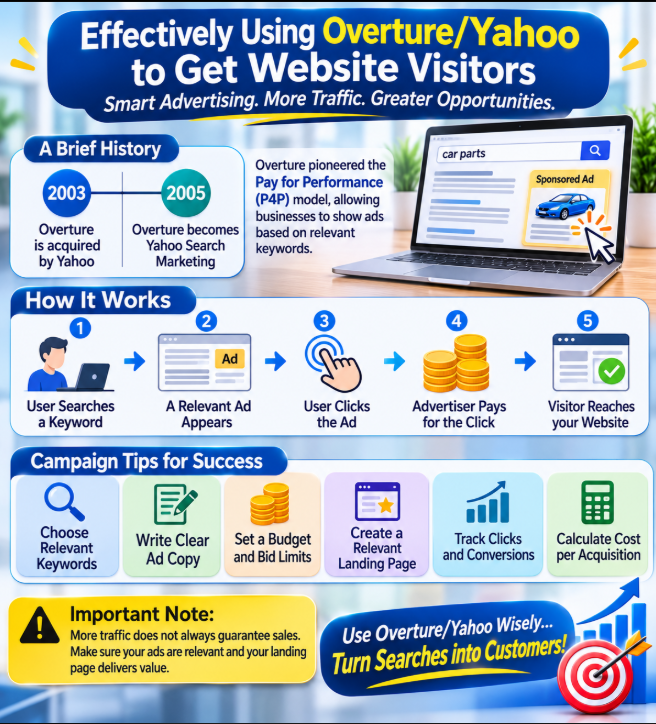
One historical platform that helped shape online advertising was Overture, a pioneer of keyword-based paid search advertising. After Yahoo acquired Overture in 2003, its advertising operations became part of Yahoo’s marketing services and were rebranded as Yahoo Search Marketing in 2005.
Overture introduced an advertising model in which businesses could pay for placement based on relevant search keywords. This approach helped establish the pay-per-click advertising model that became an important part of digital marketing.
Although the original Overture service is now part of internet advertising history, its fundamental marketing principles remain relevant.
In this guide, you will learn how keyword-based advertising works, how paid advertising can attract website visitors, and which strategies businesses can use to manage advertising campaigns more effectively.
What Was Overture and How Did It Work?
Overture was an online advertising company known for its early role in developing commercial search advertising.
Its advertising model allowed businesses to display sponsored listings when internet users searched for specific keywords or phrases.
For example, imagine that you own an online store selling automobile parts.
You could choose relevant keywords such as:
- Honda Accord parts
- Car replacement parts
- Automotive accessories
- Affordable car components
When someone searched for a relevant term, your advertisement could appear alongside the search results, depending on the campaign’s settings and advertising placement.
The advertiser paid for the advertising service, often based on clicks rather than simply the number of times an advertisement appeared.
This model became widely known as pay-per-click (PPC) advertising.
The Relationship Between Overture and Yahoo
Overture played an important role in the development of paid search advertising.
Yahoo completed its acquisition of Overture on October 7, 2003. In March 2005, Yahoo announced that Overture’s services would be brought under the Yahoo Search Marketing brand.
This historical transition helped integrate Overture’s sponsored search technology into Yahoo’s advertising business.
It is important to distinguish these historical services from modern advertising products. The original Overture platform is not a current standalone advertising service.
Yahoo continues to operate advertising products, including Yahoo DSP, which provides a different modern advertising platform for advertisers.
Understanding Pay-for-Performance Advertising
Pay for Performance (P4P) is an advertising concept in which payment is connected to measurable advertising results.
In the context of Overture’s historical search advertising model, advertisers paid for sponsored placement and traffic generated through clicks.
This approach offered businesses a way to connect advertising expenses with measurable user interactions.
How Pay-Per-Click Advertising Works
The basic PPC process involves several steps:
- Choose relevant keywords: Advertisers identify the search terms that potential customers might use.
- Create an advertisement: Write a headline and description that explain the product or service.
- Set a campaign budget: Decide how much money can be spent on advertising.
- Display the advertisement: The advertising platform may show the ad when a relevant search or targeting condition is met.
- Receive clicks: Interested users click the advertisement and visit the website.
- Measure performance: Advertisers evaluate clicks, conversions, and campaign costs.
The actual placement of an advertisement depends on the advertising platform’s eligibility rules, bidding system, relevance, and other factors.
Why Is Paid Advertising Useful for Getting Website Visitors?
Organic traffic can take time to develop, particularly for new websites competing in crowded markets.
Paid advertising offers another way to reach potential customers.
Here are several advantages of using paid advertising.
1. Reach Potential Customers More Quickly
Paid advertising can help businesses introduce their websites, products, and services to potential customers without waiting for organic search visibility to develop.
For example, a new automotive parts store can advertise relevant products to people searching for specific replacement components.
This provides an additional source of website traffic.
2. Target Relevant Keywords
Keyword targeting allows advertisers to focus their campaigns on search terms related to their products or services.
For example, a company selling laptop accessories might target searches related to laptop chargers, keyboards, and protective cases.
Choosing relevant keywords helps reduce unnecessary advertising exposure.
3. Increase Brand Awareness
Even when visitors do not immediately click an advertisement, seeing a business name and message can increase brand exposure.
Repeated exposure to relevant advertising may help potential customers become more familiar with a business.
However, impressions alone do not guarantee that people will remember or purchase from the advertised brand.
4. Control Advertising Expenses
Many paid search advertising systems allow advertisers to establish budgets and bidding limits.
This makes it possible to plan advertising expenses according to available resources.
Businesses should monitor spending regularly to avoid paying for traffic that does not produce meaningful results.
5. Measure Advertising Performance
Digital advertising provides measurable performance information.
Depending on the platform, advertisers may be able to monitor:
- Impressions
- Clicks
- Click-through rate (CTR)
- Average cost per click (CPC)
- Conversions
- Cost per acquisition (CPA)
- Return on ad spend (ROAS)
These measurements help businesses understand whether their advertising investments are producing useful results.
How to Choose the Right Keywords for Advertising
Keyword selection is one of the most important parts of a successful search advertising campaign.
Choosing keywords that are too broad may attract visitors who have little interest in your products or services.
Instead, focus on search terms that reflect the needs and intentions of your potential customers.
1. Understand Customer Search Intent
Think about what potential customers are trying to accomplish when they search online.
For example, someone searching for “what is a car battery” may be looking for general information.
Someone searching for “buy Honda Accord car battery” may have a stronger purchasing intention.
Understanding this difference can help you create more relevant advertising campaigns.
2. Use Specific Keywords
Specific keywords often provide clearer information about what a visitor wants.
For example:
- Broad keyword: Car parts
- More specific keyword: Honda Accord replacement parts
- Product-focused keyword: Honda Accord brake pads
The most appropriate keyword depends on the products you sell and the audience you want to reach.
3. Avoid Irrelevant Search Terms
Review search terms and identify queries that generate clicks without bringing relevant visitors.
Use negative keywords where supported by the advertising platform to reduce unwanted traffic.
For example, a business selling new automotive components may want to exclude searches related to free used parts.
4. Organize Keywords into Relevant Groups
Group similar keywords into separate advertising campaigns or ad groups.
For example, an automotive parts store could organize its campaigns into:
- Engine Components
- Brake Systems
- Car Batteries
- Automotive Accessories
This makes it easier to create advertisements that closely match the keywords being targeted.
How to Create an Effective Paid Advertising Campaign
Selecting keywords is only the beginning. Your advertisement and landing page also need to provide a useful experience.
Here are some important campaign practices.
1. Write Clear and Relevant Advertisements
Your advertisement should explain what you offer and why it may be useful to potential customers.
Avoid misleading headlines or promises that your website cannot fulfill.
A good advertisement should be directly related to the keywords and the destination page.
2. Create a Relevant Landing Page
When visitors click your advertisement, they should arrive at a page that matches their expectations.
For example, someone clicking an advertisement for Honda Accord brake pads should be directed to a relevant product page rather than a general homepage.
This makes it easier for visitors to find what they are looking for.
3. Set a Realistic Advertising Budget
Determine how much you can afford to spend before launching a campaign.
Start with a manageable budget and monitor its performance.
Avoid increasing spending simply because the number of clicks is growing.
The objective is to attract valuable visitors, not just generate large traffic numbers.
4. Monitor Campaign Performance
Review campaign data regularly.
Pay attention to the relationship between advertising expenses and meaningful business outcomes.
For example, if an advertisement receives many clicks but generates very few purchases, investigate whether the keywords, advertisement, or landing page need improvement.
5. Test Different Advertising Messages
Experiment with different headlines, descriptions, and calls to action.
Compare their performance to identify which messages attract more relevant visitors and generate better results.
Make changes based on actual campaign data rather than assumptions.
Understanding Advertising Costs and Return on Investment
Paid advertising requires financial investment.
The amount businesses spend depends on factors such as competition, keywords, bidding strategies, audience targeting, and the advertising platform.
Two common advertising measurements are cost per click and cost per acquisition.
Cost Per Click (CPC)
CPC measures how much an advertiser pays for each click.
For example, if a campaign spends $100 and receives 200 clicks, the average cost per click is:
CPC = Total Advertising Cost ÷ Total Clicks
$100 ÷ 200 = $0.50 per click.
Cost Per Acquisition (CPA)
CPA measures how much an advertiser spends to obtain a specific conversion, such as a purchase or customer registration.
For example, if a campaign spends $200 and generates 10 purchases:
CPA = Total Advertising Cost ÷ Total Conversions
$200 ÷ 10 = $20 per purchase.
These measurements provide a better understanding of advertising efficiency than website traffic alone.
Why More Visitors Do Not Always Mean More Sales
A campaign may attract thousands of visitors without generating many purchases.
This can happen when:
- Advertisements target irrelevant keywords.
- Visitors do not find the products they expect.
- Landing pages are confusing.
- Product prices are not competitive.
- The checkout process is difficult.
- Visitors are not ready to purchase.
For this reason, businesses should evaluate traffic quality and conversions rather than focusing only on visitor numbers.
Paid Advertising and Search Engine Optimization: What Is the Difference?
Paid advertising and search engine optimization (SEO) are two different approaches to attracting website visitors.
Paid advertising involves paying an advertising platform to display promotional content to a selected audience.
SEO focuses on improving website content, technical accessibility, and overall search relevance to earn organic visibility in search results.
Both strategies can support a digital marketing plan.
Paid advertising may help businesses reach potential customers more quickly, while SEO can build long-term organic visibility.
A balanced strategy can use both approaches according to business goals and available resources.
Can Modern Businesses Still Use Yahoo Advertising?
The original Overture advertising system should be treated as a historical platform rather than a service that businesses can sign up for today.
However, Yahoo continues to offer modern advertising technology.
One example is Yahoo DSP, a demand-side platform that allows advertisers to plan, manage, and optimize digital advertising campaigns across supported advertising inventory.
Businesses interested in Yahoo’s current advertising products should review the available services, targeting capabilities, pricing arrangements, and eligibility requirements before making a decision.
The key lesson from Overture remains relevant: advertising should connect the right message with the right audience and produce measurable business results.
Final Thoughts
Overture played an important role in the development of keyword-based paid search advertising and helped establish an advertising model that influenced the wider digital marketing industry.
Its acquisition by Yahoo in 2003 and subsequent rebranding into Yahoo Search Marketing marked an important chapter in the history of online advertising.
Although the original Overture platform is no longer a standalone service, the principles behind its advertising model remain useful.
Businesses can still apply these principles by selecting relevant keywords, creating clear advertisements, managing budgets carefully, and measuring campaign performance.
Remember that successful online advertising is not simply about attracting more visitors. It is about reaching people who are genuinely interested in what your business offers.
By combining targeted advertising, useful landing pages, effective SEO, and consistent performance analysis, businesses can build a more sustainable digital marketing strategy.
